Probability· Note 02

Uniform Sample Space

Year 2 · Semester ElulLast updated

\renewcommand{\u}{\cup}\newcommand{\n}{\cap}\newcommand{\comp}[1]{\overline{#1}}\newcommand{\trig}[1]{\overline{#1}\,\theta}
cos‾ θ\trig{cos}

Probability Space

Definition:

A probability space is a sample space \Omega together with a probability function (mapping events [subsets of Ω\Omega] to the interval [0,1]) which satisfies the following two axioms:

Axioms of a Probability Space

  1. P(Ω)=1P(\Omega)=1
  2. If AA and BB are disjoint events, then:
P(A∪B)=P(A)+P(B)P(A\cup B)=P(A)+P(B)
Example 1

A=A= The high temp for today ∈[28∘,33∘)\in [28^\of, 33^\of)
B=B= The high temp for today ∈[33∘,38∘]\in [33^\of, 38^\of]

A,BA,B are disjoint, because there is no outcome that can be in both sets.
Suppose P(A)=0.7P(A)=0.7, P(B)=0.15P(B)=0.15.
Then, P(A∪B)=0.7+0.15=0.85P(A\cup B)=0.7 + 0.15=0.85

Example 2

A=A= Pass the math exam
B=B= Pass the computers exam

A,BA,B are not disjoint, because an outcome can be in both AA and BB. (Passing both exams)
P(A∪B)P(A\cup B) is not P(A)+P(B)P(A)+P(B).

Example 3

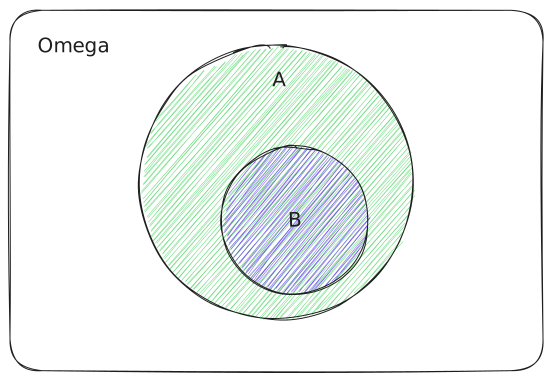
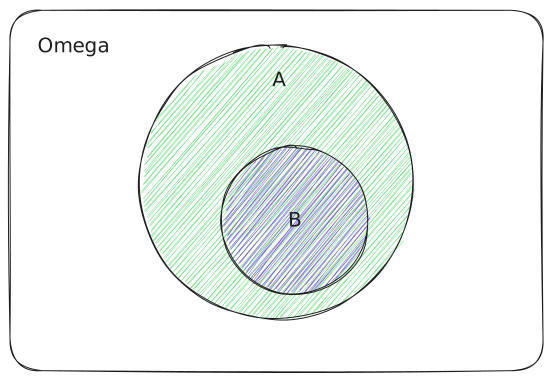
A 6-sided die is rolled.
A=A= roll ≥ 2
B=B= roll ≥ 4

A⊆BA\subseteq B because every outcome in BB is also in AA.

Properties of a Probability Space

  1. P(A‾)=1−P(A)P(\overline A)=1-P(A)
    • Proof: A,A‾A, \overline A are disjoint events (A∩A‾=∅A\cap\overline A=\varnothing), and A∪A‾=ΩA\cup \overline A=\Omega. Therefore, P(A)+P(A‾)=P(Ω)=1⟹P(A‾)=1−P(A)P(A) + P(\overline A)=P(\Omega)=1\Longrightarrow P(\overline A)=1-P(A).
  2. P(∅)=0P(\varnothing)=0
    • Proof: ∅=Ω‾\varnothing=\overline\Omega, so by property 1: P(∅)=1−P(Ω)=1−1=0P(\varnothing)=1-P(\Omega)=1-1=0
  3. If B⊆AB\subseteq A, then P(B)≤P(A)P(B)\leq P(A)
    • Proof Omitted
  4. If B⊆AB\subseteq A, then P(A)−P(B)=P(A∩B‾)P(A)-P(B)=P(A\cap\overline B)
    • Proof Omitted
  5. For any events A,BA,B:
    1. P(A∩B)≤P(A)≤P(A∪B)P(A\cap B)\leq P(A)\leq P(A\cup B)
    2. P(A∩B)≤P(B)≤P(A∪B)P(A\cap B)\leq P(B)\leq P(A\cup B)
    • Proof Omitted
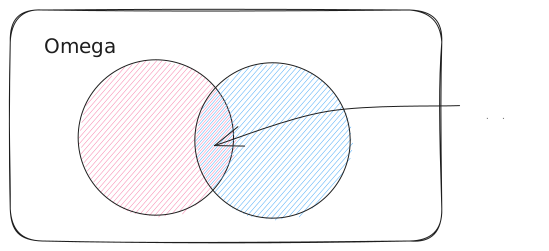
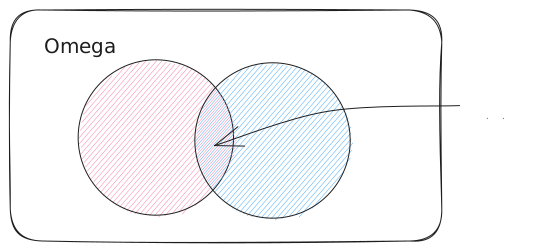
  6. For any events A,B: P(A∪B)=P(A)+P(B)−P(A∩B)P(A\u B)=P(A)+P(B)-P(A\n B)
    • Proof Omitted
Example of property 6

A=A= I pass math exam
B=B= I pass computers exam
P(A)=0.7P(A)=0.7
P(B)=0.6P(B)=0.6
P(A∪B)=0.4P(A\u B)=0.4
What is the probability of failing both exams?


The event of failing both exams is A‾∩B‾=A∪B‾\comp A\n\comp B=\comp{A\u B} (De Morgan’s Law)

P(A∪B‾)=1−P(A∪B)P(\comp{A\u B})=1-P(A\u B)

P(A∪B)=P(A)+P(B)−P(A∩B)=0.7+0.6−0.4=0.9P(A\u B)=P(A)+P(B)-P(A\n B)=0.7+0.6-0.4=0.9

P(A∪B‾)=1−0.9=0.1P(\comp{A\u B})=1-0.9=0.1