Probability· Note 03
Conditional Probability
Definition
Conditional Probability is the probability of A if B occurs. Denoted by .
Let A be the event of rolling greater than a three.
Let B be the event of rolling an even number.
We are told that B happens. Now what is the probability of A?
Given our ,
The Formula
Let A be the event that Reuven has exactly 2 boys.
Let B be the event that Reuven has at least one boy.
Given that Reuven has at least one boy, what is the probability of Reuven having 2 boys?
Applying The Formula,
Since ,
Independent Events
Events and are independent events if
(Meaning, if knowing happened has no effect on the probability of .)
Properties of Independent Events
- Independence is mutual.
- If , then .
- are independent
- This extends to mutually independent events.
Disjoint events are not the same thing as independent events.
In fact, if , then if they are disjoint must be dependent.
Evaluating Conditional Probabilities
I visit New York
I visit the Statue of Liberty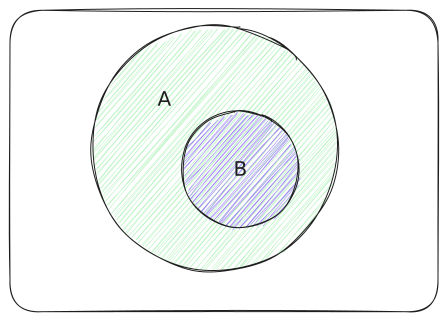
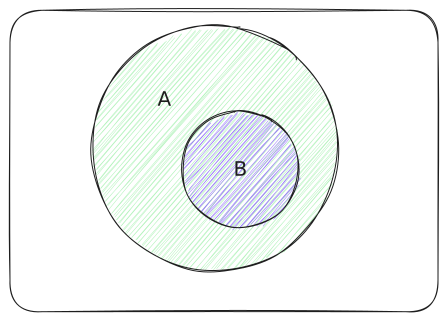
Given and , what is ?
because .
By definition: .
Multiplying both sides by gives us:
Law of Total Probability (LTP)
Introductory Example
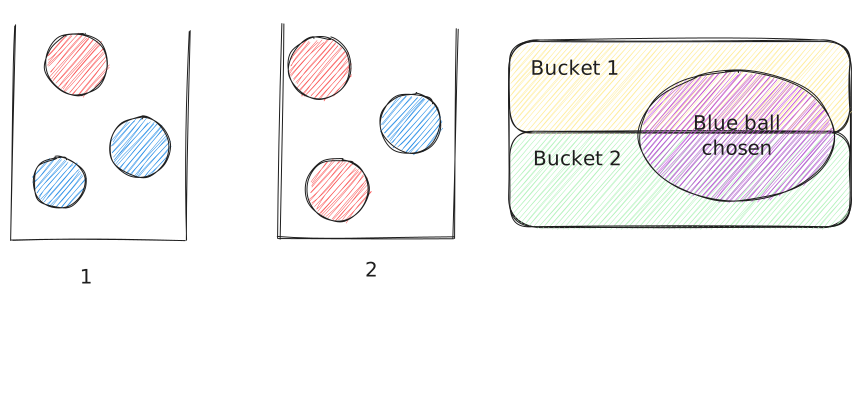
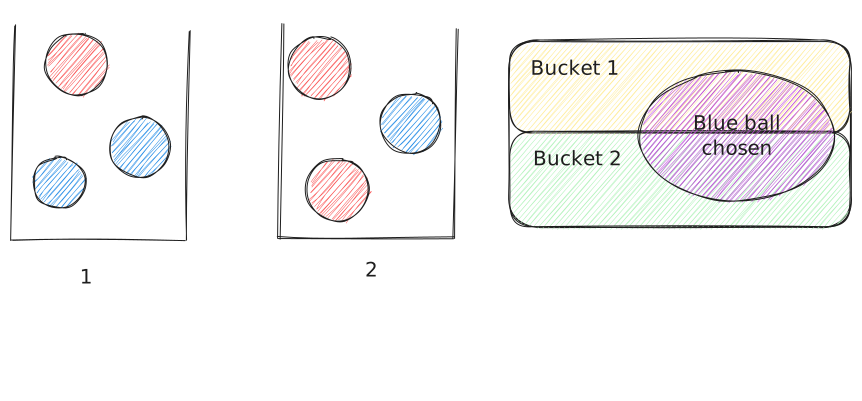
The probability of picking jar 1 is , and picking jar 2 is . A ball is selected at random from the chosen jar. What is the probability that I select a blue ball?
Define events:
We know , .
, .
So, how do we find ?
Note that , which are disjoint events.
, hence,
, hence,
Let be disjoint events which partition .
Let be any event.
Then:
The Law
is the union of the intersection of and , for all :
Then,
Proof
This is very likely on the #ProbabilityExam
I’m a bit behind on notes and stuff. If this note been published more than 10 days ago (you can see on the footer), please let me know and I’ll be sure to finish this page up