In Rn:
let v=(v1,v2,…,vn)
let u=(u1,u2,…,un) v⋅u=((v1⋅u1)+(v2⋅u2)+⋯+(vn⋅un))
For any v:v⋅v=x2+y2=∥v∥2 ∥v∥=v⋅v
Properties
If u,v,w are vectors in R2 or R3 and k is a scalar, then:
u⋅v=v⋅u
u⋅(v+w)=u⋅v+u⋅w
k(u⋅v)=(ku)⋅v=u⋅(kv)
v⋅v>0 if v=0 and v⋅v=0 if v=0
Angle between vectors
The angle θ between u and v is defined as the angle ≤ 180° formed by u and v when their tails coincide.
The angle is calculated as follows:
cos(θ)=∥u∥⋅∥v∥u⋅v
Example:
Proof is at 23:04
What if θ is 0°? well, cosθ=1 , so there ya go. If θ is 180°, cosθ=−1, and there ya go too. Conclusion: vectors are ⟂ ⟺ their dot product is zero. These are called orthogonal vectors.
Cross Product
Only defined in R3
Output is a vector, not a scalar
Definition:
Let u = <x1,y1,z1>,v = <x2,y2,z2>. Then,
A faster way to calculate it, (and the "normal way") is as follows.
Write out u above v in a 2×3 matrix:
[x1x2y1y2z1z2]
(for k = 1, 2, 3): Calculate the determinant of 2x2 matrix remaining by ignoring kth column, this becomes the kth component of the cross product
The middle component (k=2) of u×v is the negative of determinant calculated in step 2. (No changes for k=1,k=3)
Corollaries:
If u, v have same or opposite directions (i.e., v=c⋅u∣c∈R , then parallelogram they form is degenerate with area of 0, hence: If the length of the crossproduct is 0, the crossproduct is the zero vector)
Area of Triangle ABC is half area of parallelogram formed by u and v, hence, area=21∥u×v∥
Representing Lines and Planes
Lines in R2:
A new way to obtain this equation:
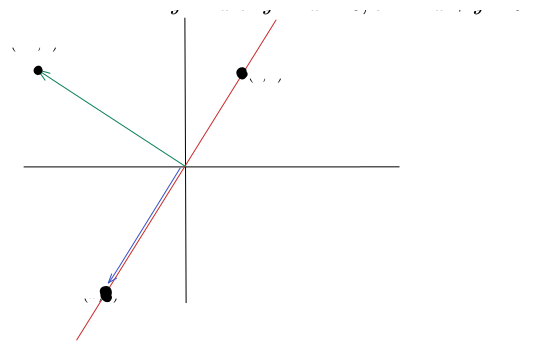
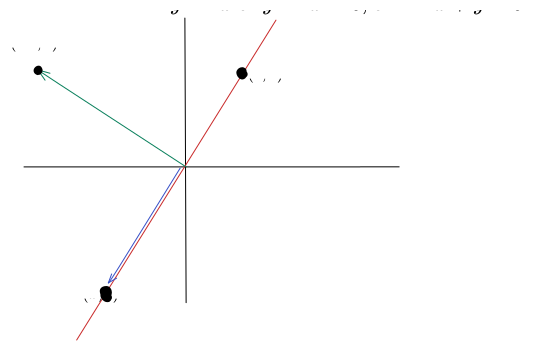
Let (x,y) be any point on ℓ. Since ℓ goes through origin, (x,y) is also a direction vector of ℓ.
i.e. Direction of ℓ = direction of vector (x,y).
Using considerations of slope, the vector (−2,1) is orthogonal to any vector in direction of ℓ.
We call (−2,1) a normal vector to ℓ.
Hence, (−2,1)⋅(x,y)=0⟹−2x+y=0 (see diagram)
Meaning, n⋅(x,y)=0∣∀(x,y)∈ℓ
How to represent a line in R2.
Get direction vectorv of l by subtracting 2 points on ℓ (because l might not go through the origin).
If slope of line = m, Normal vector n = (1,−m1) or any multiple of this.
Line equation is: n⋅(x,y)=0, and when unwrapped, looks like this:
<nx,ny>⋅<x,y>=0⟹(nx⋅x)+(ny⋅y)=0
Planes in R3:
The set of directions ⟂ to a given vector in R3 is a plane.
Ex. If (a,b,c)=(0,0,1) [z-axis], then “perpendicular directions” are (x,y) - plane: (x,y,0)
{(0,0,1)⋅(x,y,0)∣x,y∈R}
Conclusion: ax + by + cz = 0 describes a plane through origin, to which <a, b, c> is a normal vector.
For any vector (x,y,z) in this plane, (a,b,c)⋅(x,y,z)=0
General planes in R3:
Let plane P1 be a plane through the origin with a normal vector of (2, 1, 3).
Equation of P1 is 2x+y+3z=0.
Let plane P2 be parallel to P1, just shifted so it goes through (6,1,−3).
What’s the equation of P2?
Let v be one direction vector on P2.
Let (x,y,z) be any point in P2.
v=(x−6,y−1,z+3). (just because it’s a direction)
The normal vector to P1=the normal vector to P2
This is because P2 is parallel to P1.
Equation is: (x−6,y−1,z+3)⋅n=0⟹⋯⟹2x+y+3z=4
Note the similarities between equations of parallel planes P1:2x+y+3z=0 P2:2x+y+3z=4
Conclusion: Any plane in R3 has equation of ax+by+cz=d, where (a,b,c) is a normal vector to the plane.
Ex: Find equation of plane with normal of (−1,4,2) going through the point (0, 1, -3)
Use the normal vector to get a general equation: −x+4y+2z=d
Then, plug in our point (0,1,−3) to find d:
−1(0)+4(1)+2(−3)=−2
Putting it all together, we get: −x+4y+2z=−2
Lines in R3
A line in R3 cannot be described using a single equation. Instead, we describe it parametrically - that is, we describe it as a set of points using a parameter (usually t).
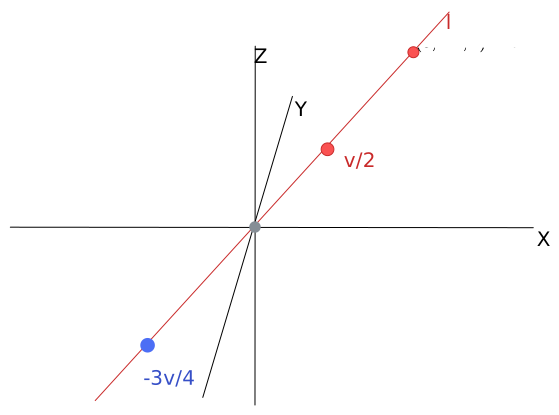
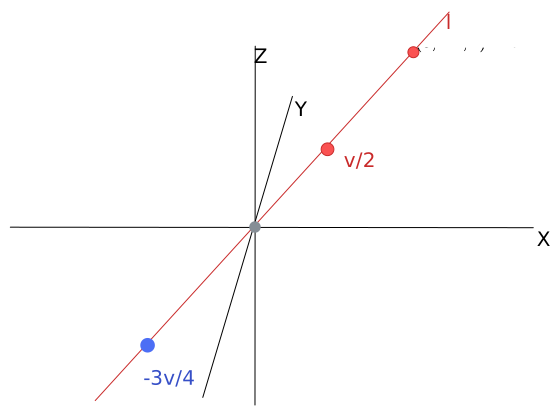
If ℓ goes through origin and v is any point on ℓ (in example, v=(3,−2,4)), then ℓ consists exactly of all scalar multiples of v.⇒ℓ={t⋅v∣t∈R}. This is the parametric form.
Cool, but what about lines not through the origin?
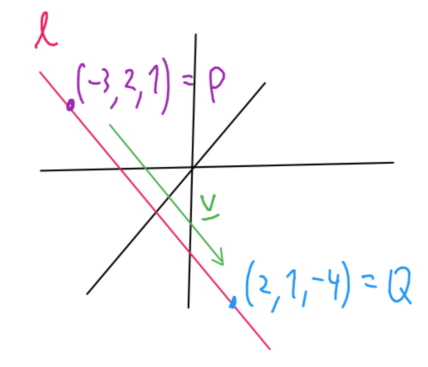
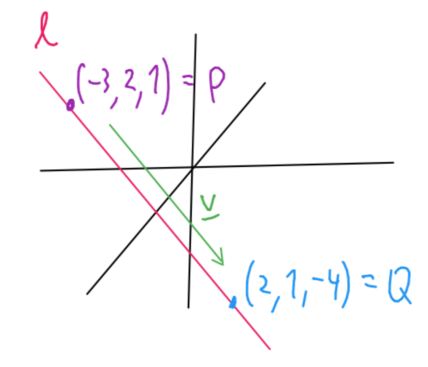
If v is a direction vector of ℓ, then every point on ℓ is of form P+t⋅v for some t∈R.