Data Structures II· Homework

HW III - Recurrence of the S-ith value

Year 2 · Semester ILast updated

Super Important Introduction

In the tapestry of algorithms, two names resound,
Benji Tusk and Eyal Schachter, profound,
Their minds, a symphony of intellect’s grace,
Embark on a journey, a recursive embrace.

With pens poised and hearts alight,
They venture into complexity’s sight,
In the realm where algorithms dance and weave,
They seek the rhythm their minds perceive.

Recursive melodies, they aim to divine,
In the labyrinth of time, where patterns entwine,
Benji’s insight, a beacon so bright,
Eyal’s logic, a guiding light.

Together they traverse the recursive maze,
In pursuit of truths, in myriad ways,
Analyzing runtimes, each algorithm’s flight,
In the waltz of complexities, they find delight.

From towering structures to intricacies small,
They unravel the mysteries, they heed the call,
In the tapestry of data, where brilliance gleams,
Benji Tusk and Eyal Schachter, dreamers of dreams.


Eyal Schachter (209792266) and Benji Tusk (650282680)

Question One

Part A

T(n)=2T(n2)+n3a=2b=2f(n)=n3nlog⁡ba=nlog⁡22=n1=nf(n)=Ω(n1+ϵ)(Case III)for any 0<ϵ<2a⋅f(nb)=2(n2)3=2n323=n322=n34We can can take any c between 14 and 1∴T(n)=Θ(n3)\begin{align} T(n)&=2T\left(\frac n2\right)+n^3\\ a=2\\b=2\\f(n)=n^3\\ n^{\log_ba}&=n^{\log_22}=n^1=n\\ f(n)&=\Omega(n^{1+\epsilon})\qquad\text{(Case III)}\\ \text{for any }0<&\epsilon<2\\ \\ a\cdot f\left(\frac nb\right)&=2\left({\frac n2}\right)^3\\ &=2\frac{n^3}{2^3}\\ &=\frac{n^3}{2^2}=\frac{n^3}{4}\\ \text{We can can take any }&\text{$c$ between $\frac14$ and 1}\\ \therefore T(n)&=\Theta(n^3) \end{align}

Part B

T(n)=T(n3)+2log⁡nT(n)=T\left(\frac n 3\right) + 2\log n

We cannot use the Master Method, so we use iteration:

T(n)=T(n3)+2log⁡n=T(n32)+2log⁡n3+2log⁡n…=T(n3i)+∑j=0i−12log⁡n3j=T(n3i)+2[∑j=0i−1(log⁡n−log⁡3j)]=T(n3i)+2[∑j=0i−1log⁡n−∑j=0i−1log⁡3j]=T(n3i)+2[ilog⁡n−∑j=0i−1log⁡3j]=T(n3i)+2ilog⁡n−2∑j=0i−1log⁡3j=T(n3i)+2ilog⁡n−2∑j=0i−1jlog⁡(3)=T(n3i)+2ilog⁡n−2log⁡(3)∑j=0i−1j=T(n3i)+2ilog⁡n−2log⁡(3)i2−i2=T(n3i)+2ilog⁡n−log⁡(3)⋅(i2−i)Bottom Row is where i=log⁡3(n)T(n)=T(1)+2⋅log⁡3n⋅log⁡2n−log⁡23(log⁡32n−log⁡3n)≤2⋅log⁡3n⋅log⁡2n−log⁡23⋅log⁡32n+log⁡23⋅log⁡3n=2⋅log⁡3n⋅log⁡3nlog⁡32−1log⁡32⋅log⁡32n+1log⁡32⋅log⁡3n=2log⁡32⋅log⁡32n−1log⁡32⋅log⁡32n+1log⁡32⋅log⁡3n=1log⁡32⋅log⁡32n+1log⁡32⋅log⁡3n≤1log⁡32⋅log⁡32n=log⁡3⋅(log⁡nlog⁡3)2=1log⁡3⋅log⁡2n≤clog⁡2nfor c≥log⁡3−13∴T(n)=O(log⁡2(n))\begin{align} T(n)&=T\left(\frac n 3\right) + 2\log n\\ &=T\left(\frac{n}{3^2}\right) + 2\log\frac n3 + 2 \log n\\ \dots&=T\left(\frac{n}{3^i}\right) + \sum_{j=0}^{i-1}{2\log\frac{n}{3^j}}\\ &=T\left(\frac{n}{3^i}\right) + 2\left[\sum_{j=0}^{i-1}{\left(\log n - \log{3^j}\right)}\right]\\ &=T\left(\frac{n}{3^i}\right) + 2\left[\sum_{j=0}^{i-1}{\log n - \sum_{j=0}^{i-1}\log{3^j}}\right]\\ &=T\left(\frac{n}{3^i}\right) + 2\left[i\log n - \sum_{j=0}^{i-1}\log{3^j}\right]\\ &=T\left(\frac{n}{3^i}\right) + 2i\log n - 2\sum_{j=0}^{i-1}\log{3^j}\\ &=T\left(\frac{n}{3^i}\right) + 2i\log n - 2\sum_{j=0}^{i-1}j\log{(3)}\\ &=T\left(\frac{n}{3^i}\right) + 2i\log n - 2\log{(3)}\sum_{j=0}^{i-1}j\\ &=T\left(\frac{n}{3^i}\right) + 2i\log n - 2\log{(3)}\frac{i^2-i}{2}\\ &=T\left(\frac{n}{3^i}\right) + 2i\log n - \log{(3)}\cdot(i^2-i)\\\\ &\text{Bottom Row is where }i=\log_3(n)\\\\ T(n) &= T(1) + 2 \cdot \log_3 n \cdot \log_2 n - \log_2 3 (\log_3^2 n - \log_3 n) \\ &\leq 2 \cdot \log_3 n \cdot \log_2 n - \log_2 3 \cdot \log_3^2 n + \log_2 3 \cdot \log_3 n \\ &= 2 \cdot \log_3 n \cdot \frac{\log_3 n}{\log_3 2} - \frac{1}{\log_3 2} \cdot \log_3^2 n + \frac{1}{\log_3 2} \cdot \log_3 n \\ &= \frac{2}{\log_3 2} \cdot \log_3^2 n - \frac{1}{\log_3 2} \cdot \log_3^2 n + \frac{1}{\log_3 2} \cdot \log_3 n \\ &= \frac{1}{\log_3 2} \cdot \log_3^2 n + \frac{1}{\log_3 2} \cdot \log_3 n \\ &\leq \frac{1}{\log_3 2} \cdot \log_3^2 n \\ &= \log 3 \cdot \left(\frac{\log n}{\log 3}\right)^2 \\ &= \frac{1}{\log 3} \cdot \log^2 n \\ &\leq c \log^2 n \quad \text{for } c \geq \log_3^{-1} 3\\\\ \therefore T(n)&=O(\log^2(n)) \end{align}

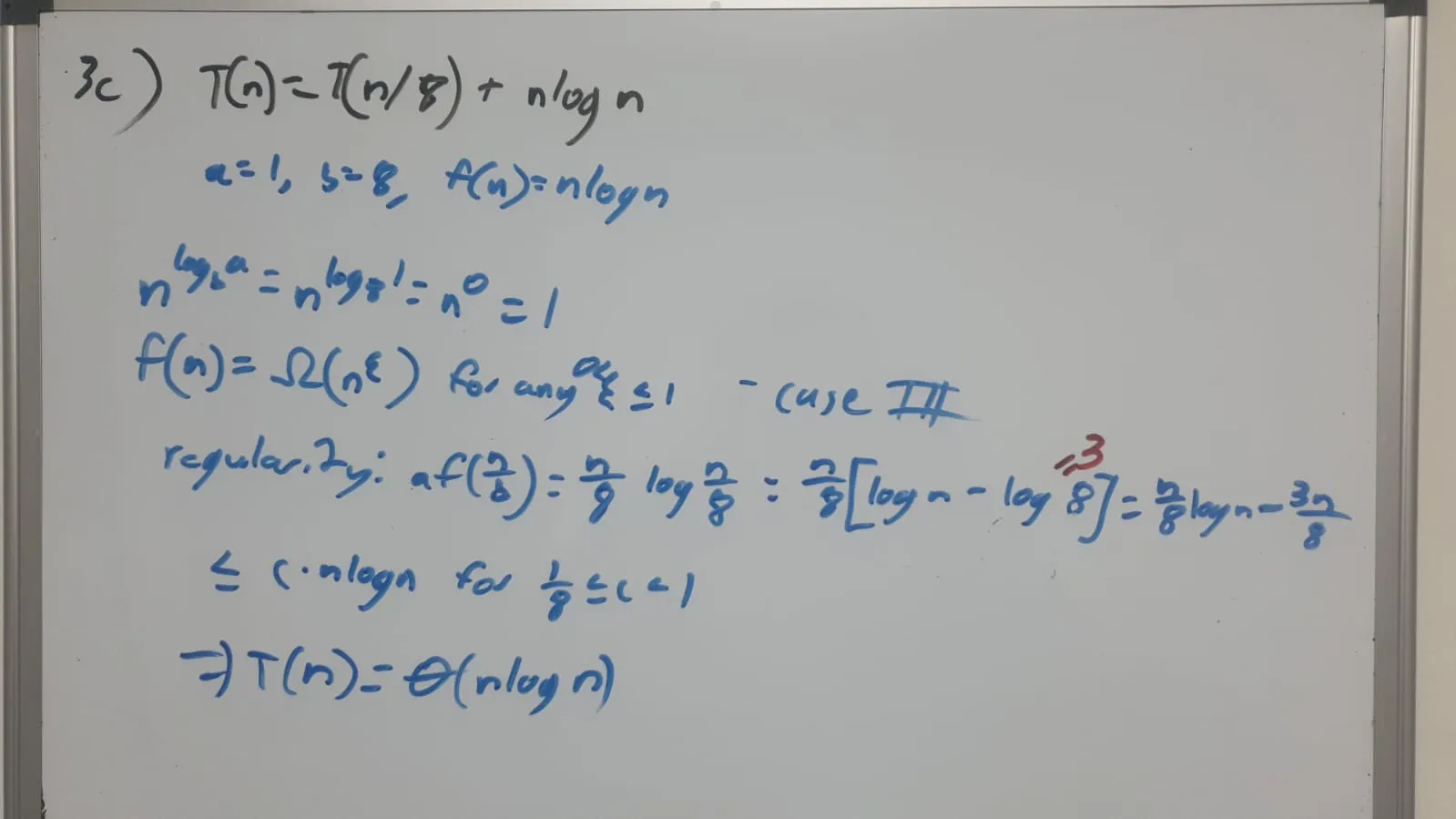
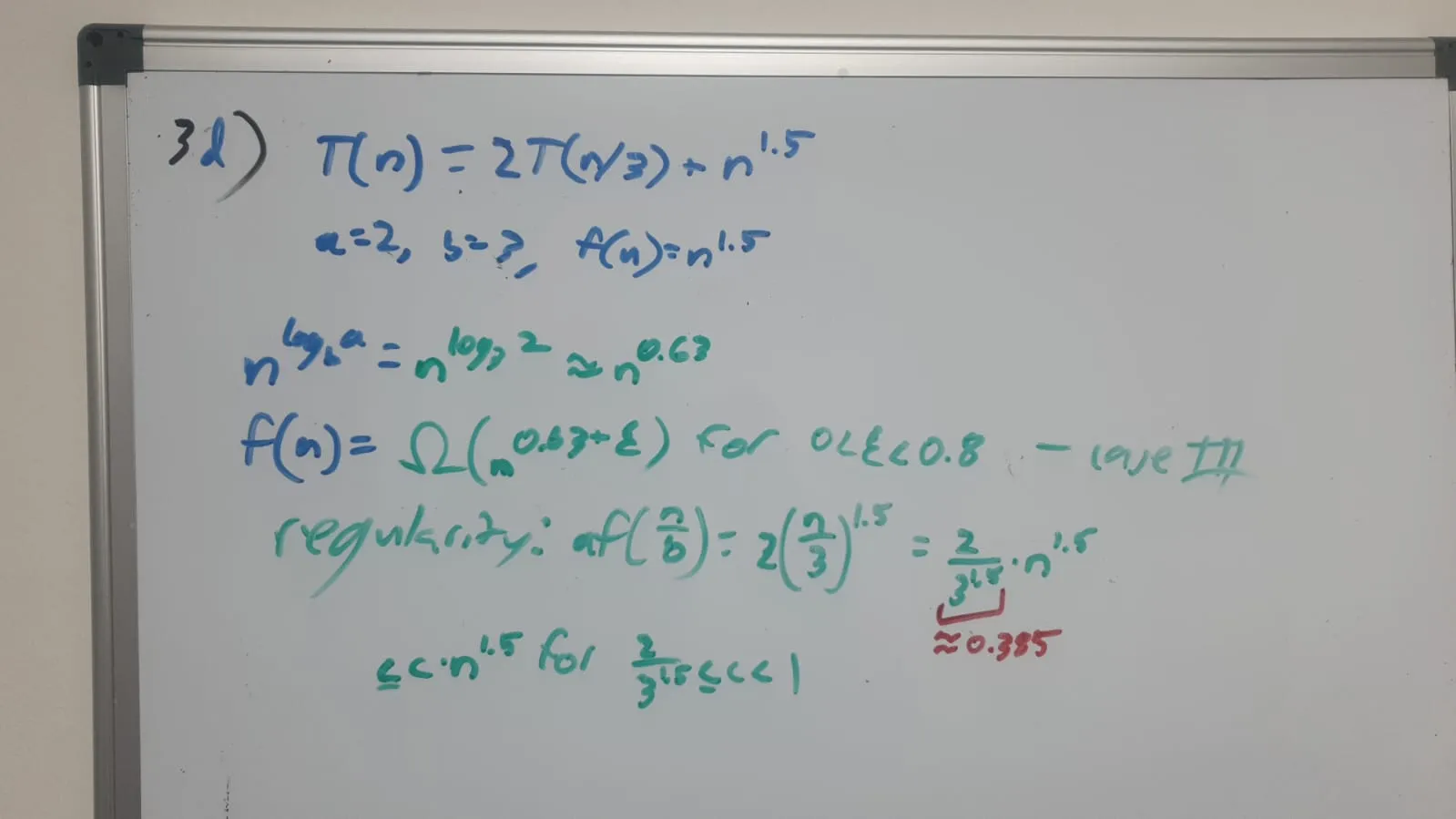
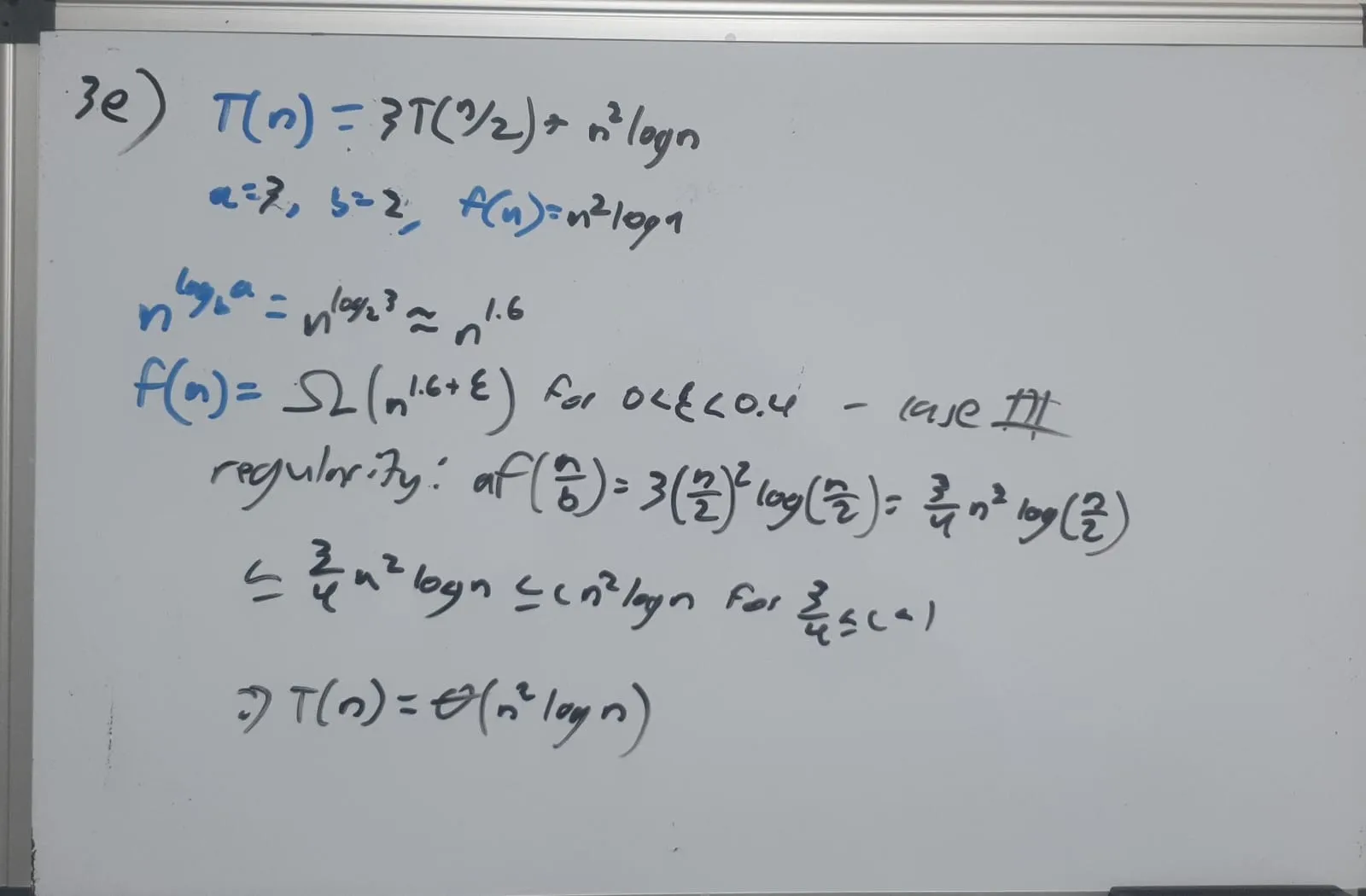
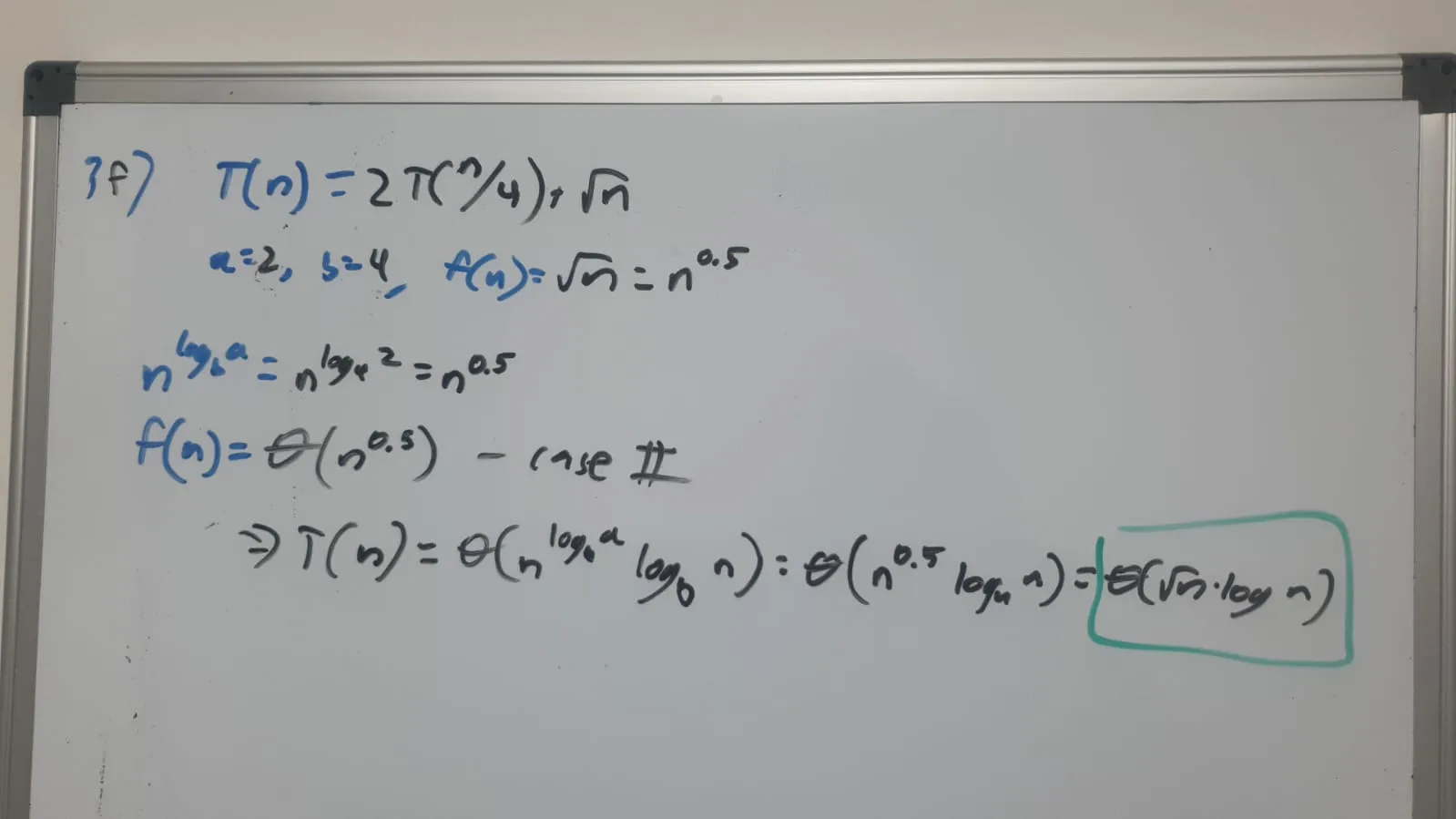
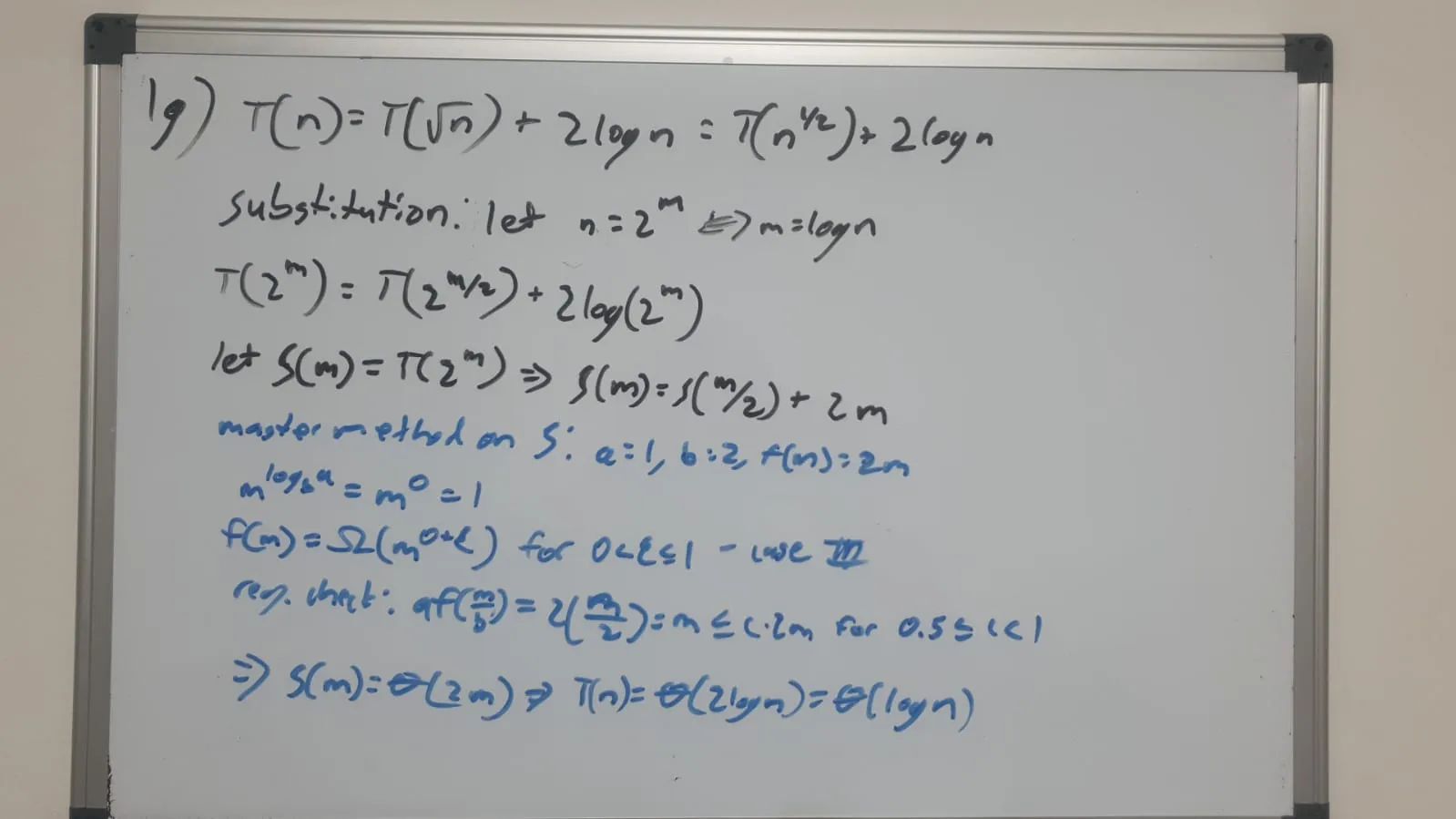
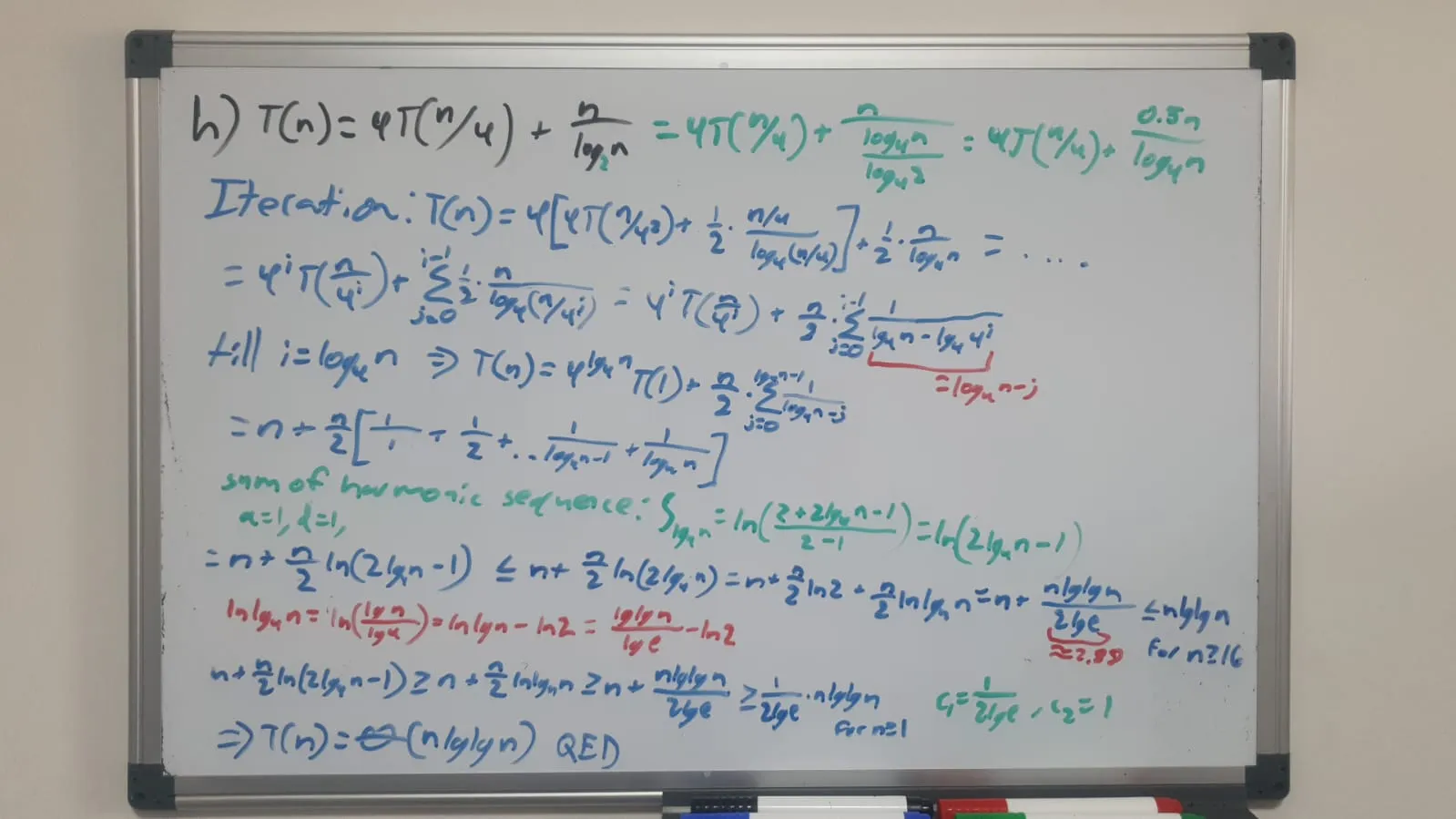
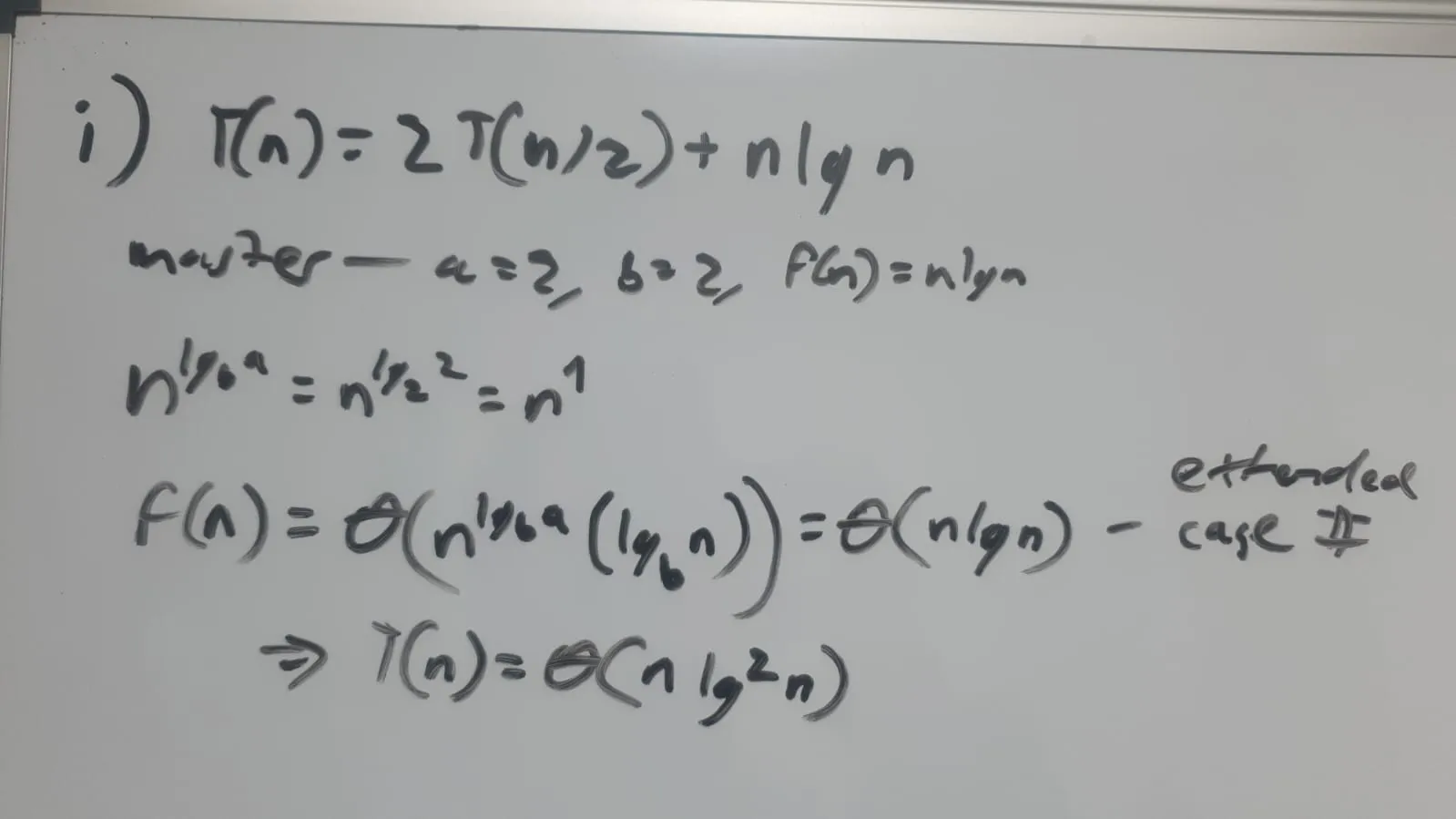
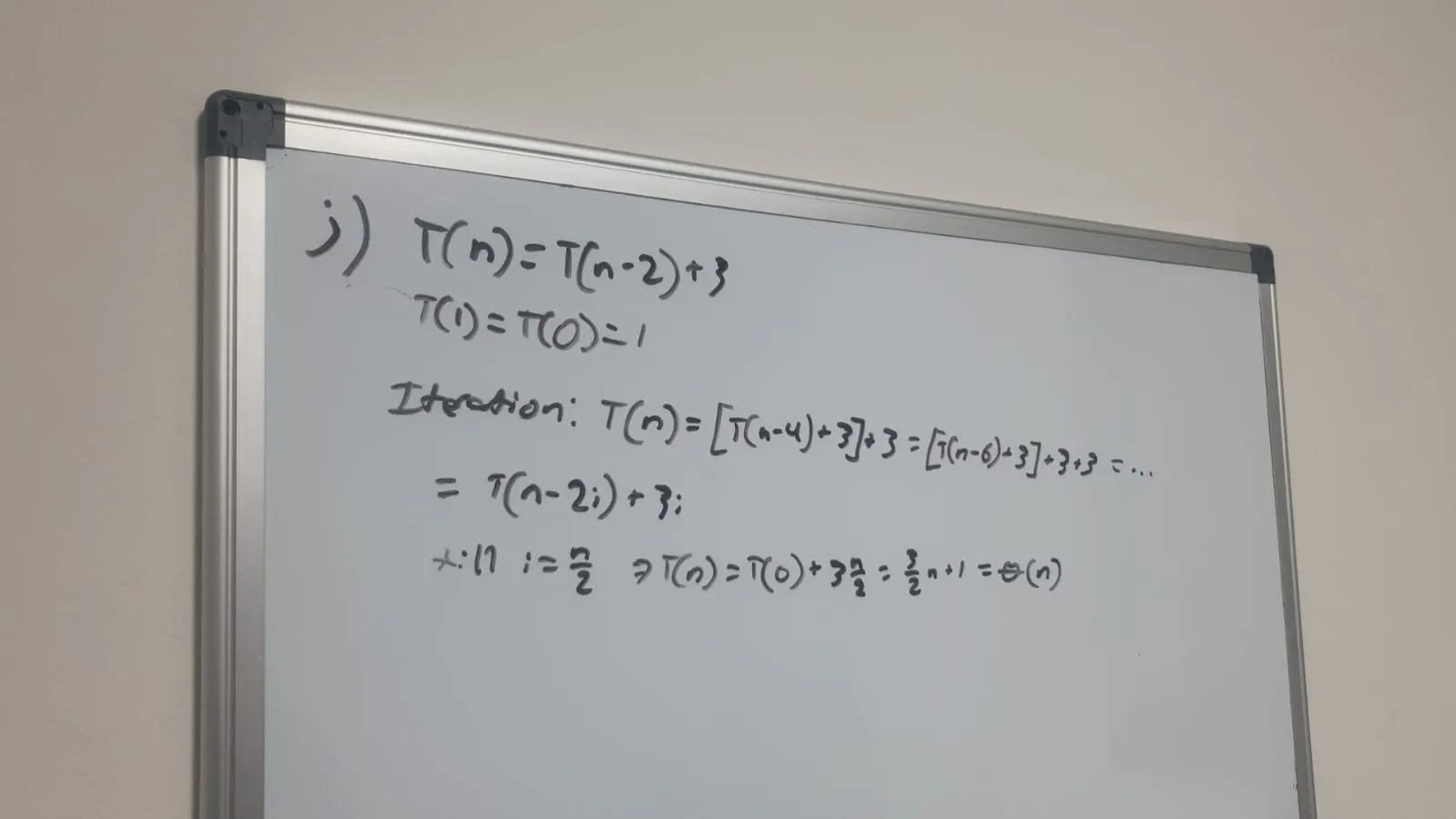
Since I cannot be bothered to transcribe the math, you’re just gonna have to deal with the pictures. Hope the poem at the top makes up for this 🙃

Part C

Part D

Part E

Part F

Part G

Part H

Part I

Part J

Question 2

T(n)=2T(⌊n2⌋)+1a=2,b=2,f(n)=1nlog⁡ba=n11=O(n1−ϵ)for 0<ϵ<1(case 1)T(n)=Θ(n)\begin{align*} T(n) &= 2T\left(\left\lfloor\frac{n}{2}\right\rfloor\right) + 1 \\ a &= 2, \quad b = 2, \quad f(n) = 1 \\ n^{\log_b a} &= n^1 \\ 1 &= O(n^{1-\epsilon}) \quad \text{for } 0 < \epsilon < 1 \\ &\quad (\text{case 1}) \\ T(n) &= \Theta(n) \end{align*}

Question 3

T(n)=T(n−1)+Θ(n)=T(n−1)+dn=[T(n−2)+d(n−1)]+dn=T(n−2)+d(n+(n−1))=T(n−3)+d(n+(n−1)+(n−2))=…=T(n−i)+d∑j=0i−1(n−j)=…=T(1)+d∑j=0n−1(n−j)=1+d(1+2+⋯+n)=1+d(n(n+1)2)=1+d2(n2+n)≤cn2for c≥d2∴T(n)=Θ(n2)\begin{align} T(n) &= T(n-1) + \Theta(n) \\ &= T(n-1) + dn \\ &= [T(n-2) + d(n-1)] + dn \\ &= T(n-2) + d(n + (n-1)) \\ &= T(n-3) + d(n + (n-1) + (n-2)) \\ &= \dots \\ &= T(n-i) + d \sum_{j=0}^{i-1} (n - j) \\ &= \dots \\ &= T(1) + d \sum_{j=0}^{n-1} (n - j) \\ &= 1 + d(1 + 2 + \dots + n) \\ &= 1 + d\left(\frac{n(n+1)}{2}\right) \\ &= 1 + \frac{d}{2}(n^2 + n) \\ &\leq cn^2 \quad \text{for } c \geq \frac{d}{2} \\\\ \therefore T(n)&=\Theta(n^2) \end{align}

Question 4

The general form of the recurrence is T(n)=T(n−k)+sort(k)+nT(n) = T(n-k) + sort(k) + n where kk is the number of elements to the left of the partition, and sort(k)sort(k) the time taken by the sorting algorithm.

We will calculate worst-case scenario, where there is no early exit (eg i=ni=n).

We will examine a few cases:

Case 1

k=1k=1, sort(k)=k2sort(k) = k^2 (bubble sort)
The recurrence is T(n)=T(n−1)+12+n=T(n−1)+θ(n)T(n) = T(n-1) + 1^2 +n = T(n-1) + \theta(n)
Using iteration, the general form is T(n)=T(n−i)+∑j=0i−1θ(n−j)T(n) = T(n-i) + \sum_{j=0}^{i-1}\theta(n-j)
We can continue until i=n−1i=n-1 (note ii here has no relation to ii from the question). T(n)=T(1)+∑j=0n−2θ(n−j)=d1+∑j=0n−2d2(n−j)=d1+d2∑j=2n(j)≤d2n2T(n) = T(1) +\sum_{j=0}^{n-2}\theta(n-j) = d_1 +\sum_{j=0}^{n-2}d_2(n-j) = d_1 +d_2\sum_{j=2}^{n}(j) \le d_2n^2
So T(n)=O(n2)T(n) = O(n^2)

Case 2

k=n2,k=\frac n2, sort(k)=klog⁡k=n2log⁡(n2)(k)=k\log k=\frac n2\log (\frac n2) (merge sort)
The recurrence is T(n)=T(n2)+n2log⁡(n2)+nT\left(n\right)=T\left(\frac n2\right) + \frac n2\log\left(\frac n2\right) + n
Which simplifies to T(n2)+n2(log⁡n+1)T(\frac n2) + \frac n2(\log n + 1).
We use the master method, where a=1,b=2,f(n)=n2(log⁡n+1)a=1,b=2,f(n)=\frac n2(\log n + 1).
nlog⁡ba=n0=1n^{\log_ba}=n^0=1
f(n)=Ω(nϵ)∣0<ϵ≤1f(n)=\Omega(n^\epsilon) \mid 0<\epsilon≤1 (Case III of Master Method)
We now check for regularity:
1⋅f(n2)≤c⋅f(n)1\cdot f(\frac n2) ≤ c\cdot f(n)
n4(log⁡(n2)+1)=n4(log⁡n−1+1)≤cn2(log⁡n+1)\frac n4(\log (\frac n2)+1) = \frac n4(\log n \cancel{-1+1}) ≤ c\frac n2(\log n + 1)
For 12≤c<1\frac 12 ≤ c < 1.

So, T(n)=O(n2(log⁡n+1))=O(nlog⁡n)T(n)=O(\frac n2(\log n + 1))=O(n\log n)

Case 3

k=n2,k=\frac n2, sort(k)=k2=(n2)2(k)=k^2={\left(\frac n2\right)}^2 (bubble sort)
The recurrence is T(n)=T(n2)+(n2)2+nT\left(n\right)=T\left(\frac n2\right) + {\left(\frac n2\right)}^2 + n
Which simplifies to T(n2)+n2+4n4T(\frac n2) + \frac{n^2+4n}4.
We use the master method, where a=1,b=2,f(n)=n2+4n4a=1,b=2,f(n)=\frac{n^2+4n}4.
nlog⁡ba=n0=1n^{\log_ba}=n^0=1
f(n)=Ω(nϵ)∣0<ϵ≤2f(n)=\Omega(n^\epsilon) \mid 0<\epsilon≤2 (Case III of Master Method)
We now check for regularity:
1⋅f(n2)≤c⋅f(n)1\cdot f(\frac n2) ≤ c\cdot f(n)
n2+8n16≤cn2+4n4\frac{n^2+8n}{16} ≤ c\frac{n^2+4n}4
For 12≤c<1\frac 12 ≤ c < 1.

So, T(n)=O(n2+4n4)=O(n2)T(n)=O(\frac{n^2+4n}4)=O(n^2)

Case 4

k=n−1k=n-1, sort(k)=klog⁡k(k)=k\log k
Since this is pretty much our ‘early exit’ case, the computation is immediate:
T(n)=T(n−k)+sort(k)+n=T(1)+(n−1)log⁡(n−1)+n=O(nlog⁡n)T(n)=T(n-k)+sort(k)+n=T(1)+(n-1)\log(n-1)+n=O(n\log n)