Data Structures Homework III - Revenge of the Bits
Oh dear graders of our homework on Data Structures,
We come to you with some humorous adventures!
We’ve spent countless hours, with recursion in mind,
Hoping our code, is the best you’ll find.
Our linked lists are linked, and our stacks are all stacked,
Our queues are all queued, not even one is hacked.
But then came the trees, with their branches so wide,
Recursing through them, was like taking a ride.
The leaves kept falling, and the nodes kept splitting,
But we kept on going, our code never quitting.
Sometimes it got messy, and sometimes we’d shout,
But we’d always find a way, to recurse it out.
We know we made mistakes, we’re not robots, you see,
But please don’t judge too harshly, be kind like a bee.
So dear graders of our homework, we hope you will find,
That our code is worthy, of an A in kind.
And if there’s still room, for improvement or fun,
We’ll keep on coding, until the recursion is done.
And if you need any help, just give us a call,
Benji and Eyal are here, to help you with it all!
Benji Tusk: 650282680
Eyal Schachter: 209792266
def recDelete(l: LinkedList, x: int):
    def recDeleteHelper(n: Node, x: int, foundFirst: bool):
        if n.next is None: # end of list
            return
        if n.next.data == x: # next is the target number
            if foundFirst: # next is the second occurrence -- delete it
                n.next = n.next.next
            else: # next is first occurrence, keep searching
                recDeleteHelper(n.next, x, True)
        else: # other number
            recDeleteHelper(n.next, x, foundFirst)
    if l.head is None:
        return
recDeleteHelper(l.head, x, l.head.data == x)def recCongruentStackDetectorInator():
if s1.is_empty() and s2.is_empty():
return True
x = s1.pop() # Pop returns None if stack is empty
y = s2.pop()
if x != y:
s1.push(x)
s2.push(y)
return False
else:
isCongruent = recCongruentStackDetectorInator()
s1.push(x)
s2.push(y)
return isCongruentdef recursiveLogCalculator(n: int, base: int):
if n < base:
return 1
return 1 + recursiveLogCalculator(n // base, base) # lg_b n = lg_b( (n/b)*b ) = lg_b(n/b) + lg_b(b)
def Question3(n: int):
return recursiveLogCalculator(n, 3) + 4 # because the powers that be said so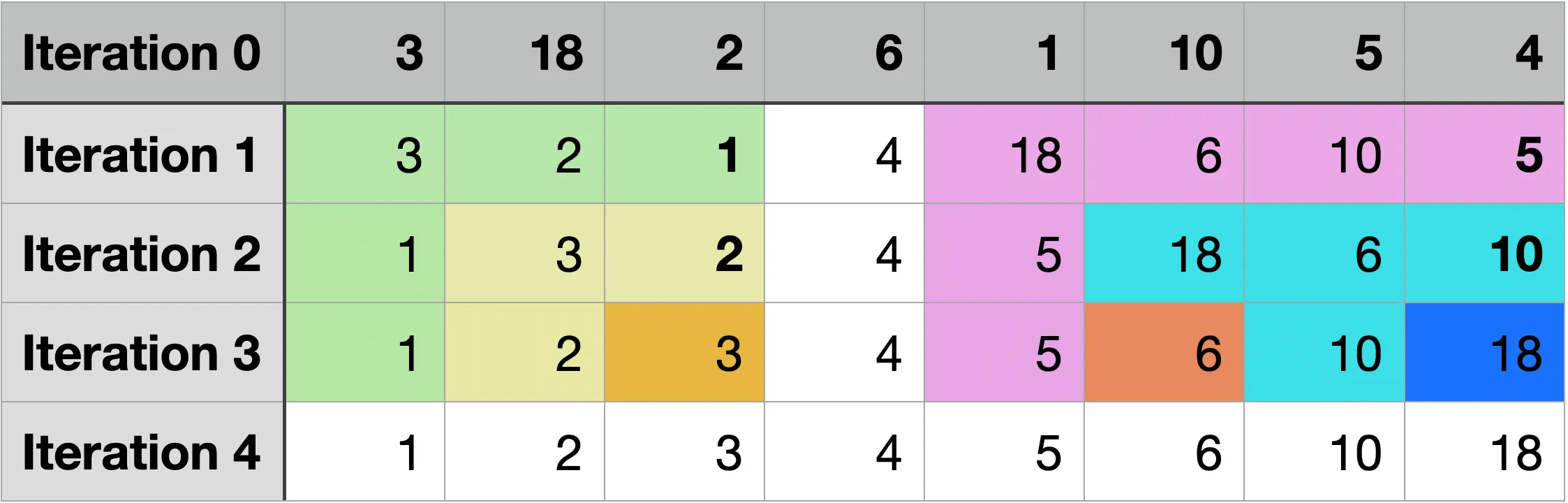
2, 3, 6, 8, 17, 4, 12, 5, 9, 13, 42, 0, 10
def isBST(t: BinaryTree) -> bool:
    def isBSTHelper(node: BinaryTreeNode, max: int, min: int) -> bool:
        if node is None:
            return True
        if node.data < min or node.data > max:
            return False
        return isBSTHelper(node.left, max=node.data, min=min) and isBSTHelper(node.right, max=max, min=node.data)

    return isBSTHelper(t.root, ∞, -∞)
Run time complexity is O(n) because it visits every node at most once.
The function returns true if every value in tree 2 is greater than all the values in tree 1
The runtime complexity is and can be likened to a rectangle, where you are checking each box. For every row ( rows) you must do comparisons. We are assuming there is short-circuit evaluation so it doesn’t need to evaluate every single comparision, otherwise it would indeed be
def initializeSize(t: BinaryTreeNode):
    if t is None: # base case
      return
    # recursively set descendents' size POSTHASTE
    initializeSize(t.left)
    initializeSize(t.right)
    t.size = 1 # the element itself
    if t.left is not None:
       t.size += t.left.size
    if t.right is not None:
       t.size += t.right.size